Most teams hit the same wall with AI pilots. The demo dazzles, but when you roll it out, things stall: the model takes seconds to reply, adoption drops, and soon everyone’s wondering if AI was just hype.
Here’s the mistake: reaching straight for the biggest model you can buy. Bigger isn’t always better. In fact, in 2025, smaller, smarter models often outperform the giants in everyday business tasks.
The Pocket Tool: Small Language Models (SLMs)
Think of SLMs as the Swiss Army knives of AI. Compact, quick, and tuned for specific jobs. They won’t write your strategy deck, but they’ll:
Score leads instantly, so sales knows where to focus.
Generate subject lines that stay on-brand.
Summarise a call before the rep has even hung up.
Top 5 SLMs to Know (2025):
Mistral 7B – general-purpose, very efficient.
LLaMA 3 8B – Meta’s strong open-weight small model.
Phi-3 Mini – Microsoft’s lightweight reasoning model.
Gemma 7B – Google’s compact, instruction-tuned model.
Falcon 7B – popular in enterprise for private deployment.
The Specialist Team: Mixture of Experts (MoE)
Now imagine you’ve got a panel of experts. You don’t ask everyone for input on every decision; you call the right person at the right time. That’s MoE.
One “expert” classifies industries in your CRM.
Another checks compliance wording in emails.
A third handles which content module a visitor sees.
Top 5 MoE Models to Know:
Mixtral 8x7B – a leading open-weight MoE model (by Mistral).
DeepSeekMoE – efficient training and inference, strong adoption in Asia.
GLaM (Google) – pioneering large-scale MoE model.
Switch Transformer (Google) – early but influential MoE architecture.
Amazon SageMaker MoE – managed MoE service for enterprise workloads.
The Think Tank: Large Language Models (LLMs)
Sometimes you really do want the big brain in the room. LLMs are brilliant when you need creativity, ambiguity, or a leap into the unknown:
Brainstorming campaign ideas.
Exploring new markets where you have little data.
Drafting concepts where variety is a strength, not a problem.
Top 5 Giant LLMs to Know:
GPT-4o (OpenAI) – versatile, multimodal, strong reasoning.
Claude 3 Opus (Anthropic) – excels in long context and safety.
Gemini 1.5 Pro (Google DeepMind) – strong with reasoning and integration.
LLaMA 3 70B (Meta) – open-weight large model, good for custom deployments.
Mistral Large – compact but powerful, a strong contender in enterprise use.
How to Decide Without a Degree in AI
Here’s the shortcut:
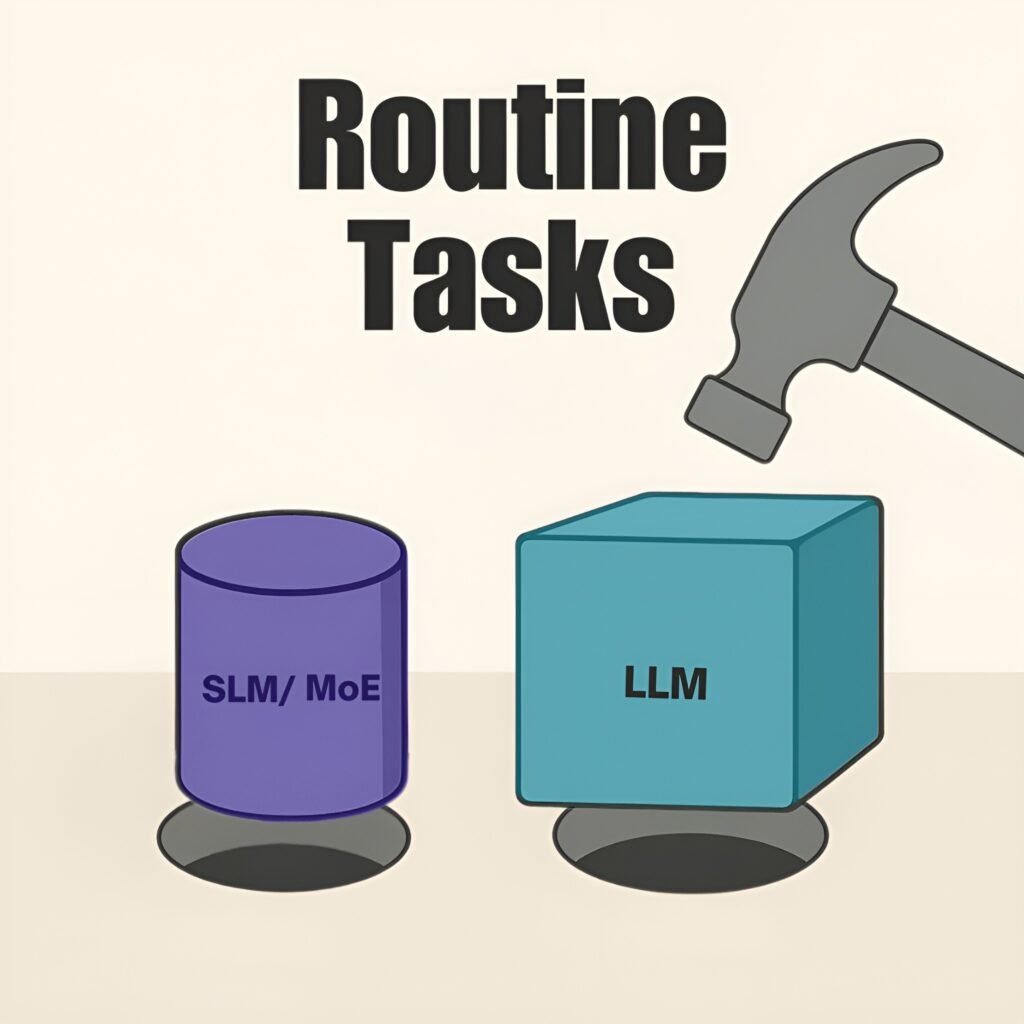
If the job is routine and repeatable → use an SLM.
If the job needs accuracy in a specialised area → use an MoE.
If the job is open-ended or creative → use an LLM.
Most of your daily growth tasks fall into the first two buckets. That’s why small and smart is winning right now.
The Takeaway
AI isn’t about picking the shiniest model. It’s about picking the right tool for the job. In 2025, that usually means starting small:
Fast enough that people actually use it.
Affordable enough that it scales.
Specific enough that the output is trusted.
Start there. Add specialists when you need them. Bring in the giant only when the problem really calls for it.
👉 That’s how you turn demos into impact.
Frequently asked questions
No. Reaching straight for the biggest model is a common reason AI pilots stall, because large models can be slow and adoption drops. Smaller, smarter models often outperform the giants in everyday business tasks. Start small, add specialist models when needed, and bring in a large model only when the problem calls for it.
A small language model, or SLM, is a compact, fast AI model tuned for specific jobs. It will not write your strategy deck, but it suits routine, repeatable tasks such as scoring leads instantly, generating on-brand subject lines or summarising a sales call. SLMs are fast enough that people use them and affordable enough to scale.
Match the model to the job. If the task is routine and repeatable, use a small language model. If it needs accuracy in a specialised area, such as compliance wording or classifying industries in a CRM, use a mixture of experts model. If it is open-ended or creative, like brainstorming campaign ideas, use a large language model.