For most of my career, there was a clear line between what big brands could do and what SMEs could afford.
TV was for companies with six-figure budgets. A proper website meant an agency or an internal development team, months of work and a significant bill. Video ads meant a production company, a shoot day and a long wait. Radio, display and landing pages each came with their own specialist and their own invoice.
That line has almost gone.
Channels that were closed are now open
In June, ITV, Channel 4 and Sky launched Universal Ads in the UK. It’s a self-serve platform that lets a business buy streaming TV across all three broadcasters from one screen, with no minimum spend, paid by card. A business that could never have considered TV can now test it with a few hundred pounds.
Audio has gone the same way. Spotify and digital radio can be booked self-serve, with ads targeted by location, age and interests, starting from a few hundred pounds.
Search and display have been self-serve for years, but the targeting and automation behind them are now far more capable than they were. A small budget, well set up, can reach exactly the right people.
Local has never had more options
This matters most for businesses that serve a town, a region or a set of postcodes.
Local advertising used to mean the local paper, a radio spot that covered half the county, or a billboard you hoped the right people drove past. Most of the money reached people who could never become customers.
Now you can target almost every channel by place. AdSmart from Sky can show a TV ad only to households in the postcodes you choose. Streaming TV, audio and digital screens in high streets and stations can all be booked by location. Search and social can be targeted too, but they need care. Google’s default settings show ads to people outside your area, and Meta charges more for tight local audiences and will quietly widen them unless you tell it not to. The options are better than ever, but the defaults are set to spend your money widely.
Set up properly, that means less wasted spend, and the chance to test a new area before committing to it. A local business can now run a campaign across TV, audio, search, social and outdoor, aimed at the people who can actually buy from them. That simply wasn’t possible a few years ago.
Assets that cost thousands now cost a fraction
The bigger change is in production.
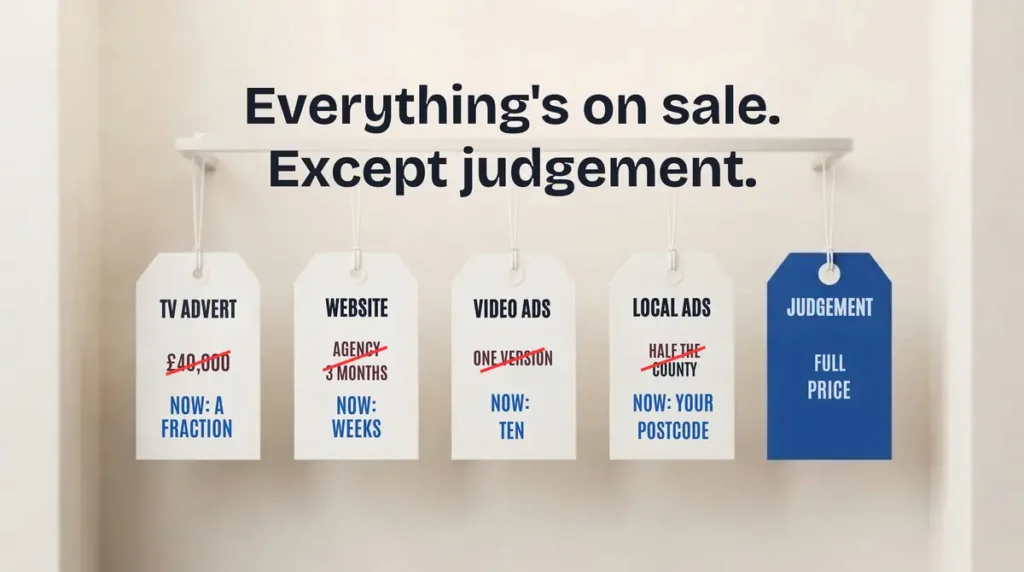
A traditional TV advert in the UK typically costs anywhere from £40,000 for a simple animation to well over £300,000. With AI video tools, a broadcast-quality ad can now be produced for a small fraction of that, in days rather than weeks.
The same is true across the board:
- Websites that needed an agency or a development team can be designed and built in days or a few weeks.
- Landing pages and funnels can be built, tested and rebuilt in days, not quarters.
- Video ads for social, YouTube and streaming TV can be made in multiple versions, so you can test what works instead of betting on one.
- Radio and audio ads, including script and voiceover, can be produced quickly and cheaply.
- Display and social creative can be produced in every size and variation a campaign needs.
For SMEs, this is the best opportunity in a generation to compete with bigger brands on more than just price.
What hasn’t got cheaper
Here’s the catch. The tools got cheaper. The thinking didn’t.
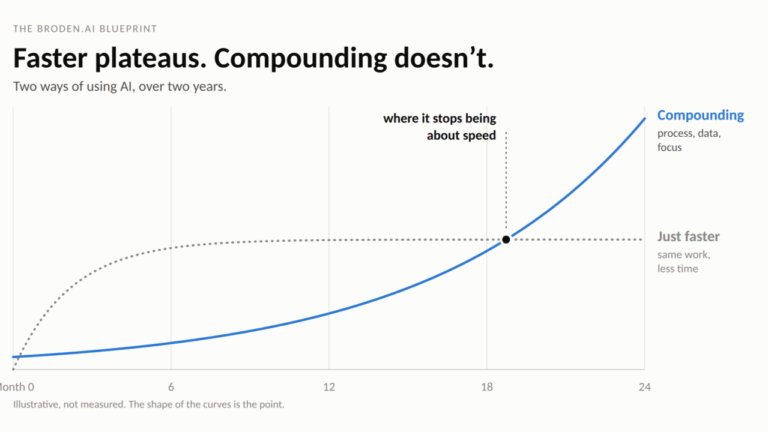
AI makes it easier to produce marketing. It doesn’t make it easier to produce good marketing. There’s a big difference between AI slop and high-quality AI output, and most people can spot it in a second. The generic stock-style video, the website that looks like every other website, the copy that says nothing in particular. Customers scroll past it, and it quietly damages the brand that paid for it.
High-quality output comes from the same place it always did: a clear brief, a sharp message, a strong sense of the brand and an experienced eye that knows what good looks like. AI speeds up the making. It doesn’t replace the judgement.
And it can’t tell you whether TV is the right channel for your business, what the ad should say, who it should reach, or how you’ll know if it worked.
When production was expensive, the cost itself forced discipline. You thought hard before spending £50,000 on a TV ad. Now that it’s cheap, it’s easy to do a lot of things quickly without asking whether any of them are the right things.
More options make this harder, not easier. When you can reach any postcode through any channel, choosing where to put the money becomes the most important decision you make.
That’s how marketing budgets leak. Lots of activity, plenty of assets, and no clear line back to the business objectives.
Where the value is now
The businesses that get the most from this shift won’t be the ones producing the most content. They’ll be the ones with someone senior deciding:
- which channels are worth testing, and which aren’t
- what the message should be, and who it’s for
- what good looks like, and what isn’t good enough to go out
- how each campaign will be measured
- when to double down, and when to stop
The tools have levelled the playing field on production and reach. The advantage now goes to whoever makes the better decisions.
If you’re wondering what this could look like for your business, I’m always happy to talk it through.
Frequently asked questions
A traditionally produced UK TV advert typically costs from around £40,000 for a simple animation to well over £300,000. AI video tools can now produce a broadcast-quality ad for a small fraction of that, in days rather than weeks. Since June 2026, Universal Ads has also let businesses buy streaming TV with no minimum spend, so it can be tested with a few hundred pounds.
Universal Ads is a self-serve advertising platform launched in the UK in June 2026 with ITV, Channel 4 and Sky. It lets a business buy streaming TV across all three broadcasters from one screen, with no minimum spend, paid by card. It opens TV to businesses that could never have considered it before.
Yes. Sky AdSmart can show a TV ad only to households in the postcodes you choose, and streaming TV, audio and digital screens can all be booked by location. Search and social need more care: Google’s default settings show ads to people outside your area, and Meta charges more for tight local audiences and will widen them unless you tell it not to.
AI slop is the generic stock-style video, the website that looks like every other website and the copy that says nothing in particular. Customers scroll past it and it quietly damages the brand. High-quality AI output comes from a clear brief, a sharp message, a strong sense of the brand and an experienced eye. AI speeds up the making, but it does not replace the judgement.
Because production got cheaper but deciding what is worth doing did not. When production was expensive, the cost forced discipline. Now it is easy to do a lot quickly without asking whether it is right. Someone senior needs to decide which channels to test, what the message is, what good looks like, how campaigns are measured, and when to double down or stop.