In 2024, over 1.3 billion blog posts were published worldwide (Worldometer). Yet the Content Marketing Institute reports only 23% of B2B marketers feel their content is “very effective.” That gap tells the story: more output, less impact.
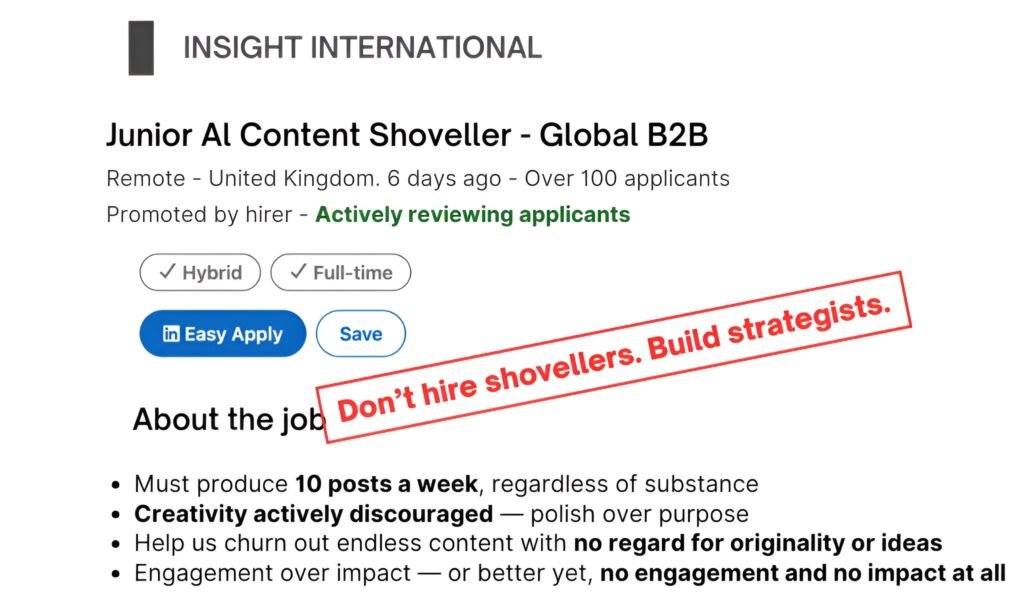
The culprit is shovelware — content created to hit a schedule, not change a mind. It looks polished, ticks SEO boxes, but doesn’t move a buyer closer to a decision. And in 2025, shovelware isn’t harmless filler — it’s a cost.
Why shovelware happens
SEO and cadence pressure: teams feel they must publish weekly to stay visible.
AI abundance: it’s never been easier to churn out derivative posts.
Misaligned metrics: clicks and likes get celebrated, even if sales never touch the asset.
The irony? More volume often suppresses engagement. LinkedIn’s own data shows that content engagement drops when posting exceeds audience appetite.
Engagement isn’t the same as business interest
One of the easiest traps to fall into is confusing engagement with impact. Articles that offer the most customer value often generate lower engagement, but can spark the right conversations — the ones that lead to pipeline.
Chasing engagement alone encourages content designed to provoke a reaction rather than progress a sale. That doesn’t mean you should avoid posts that generate reach and visibility — they build familiarity and trust. But there has to be balance.
It’s like brand versus direct response: you need both.
Posts about awards, team activities, or events usually perform well on likes and comments. They make noise, but they rarely move a deal forward.
Value-driven pieces — whitepapers, case studies, offers, propositions, frameworks — don’t always light up the feed, but they often land in the right inboxes and shape real business conversations.
The key is balance. And balance doesn’t mean 50/50 — it means designing your content strategy to align with your audience, their interests, and your offering. Too much “engagement bait” and you’ll look lightweight. Too many heavy propositions and you risk being ignored. The right mix depends on what your buyers care about, where they are in their journey, and how your product solves their problems.
What buyers actually pay attention to
Decision-makers share what helps them make a call. Edelman research shows 64% of executives say thought leadership with original research influenced their buying decisions.
Three signals matter most:
Originality – your data, your stories, your frameworks.
Clarity – plain English, not consultant-speak.
Credibility – cited stats, named sources, accountable voices.
If your content can’t pass those filters, it won’t travel inside a buying group.
How to use AI without losing your voice
AI isn’t the problem. It’s how you use it.
Research assistant → Summarises reports or highlights gaps, but you decide what’s relevant.
Structure coach → Suggests outlines; you sharpen the angle.
Draft partner → Produces a rough draft; you inject stats, stories, and stance.
Repurposing engine → Spins one strong piece into a sales one-pager, a LinkedIn post, and a webinar script.
Rule of thumb: AI provides speed; you provide originality and proof.
Better ways to measure impact
Forget vanity metrics. Focus on outcomes that connect to revenue:
Read-to-lead conversion – % of readers who take a next step.
Sales reuse rate – how often reps send the content in live deals.
Conversation velocity – how quickly prospects move from content touch to meeting.
These metrics survive attribution decay and speak the CFO’s language.
Final word
AI hasn’t made content worse. It’s made it easier to create more of it. The brands losing out are the ones mistaking engagement for impact.
The winners? They publish fewer, sharper pieces that combine human judgement with AI’s speed. They balance engagement drivers with value-driven assets. They measure by revenue, not likes.
Because in 2025, buyers don’t need more noise in their feed. They need reasons to believe.
👉 If you want to cut the shovelware, build content that actually drives revenue, and learn how to use AI as an accelerator (not a crutch), I can help.
Visit broden.ai to explore how I work with teams to design smarter, evidence-based content strategies.
Frequently asked questions
Shovelware is content created to hit a publishing schedule rather than change a buyer’s mind. It often looks polished and ticks SEO boxes, but it does not move a buyer closer to a decision. It is driven by pressure to publish frequently, the ease of producing derivative posts with AI, and metrics that celebrate clicks and likes even when sales never use the asset.
Use AI for speed and keep originality and proof for yourself. AI works well as a research assistant that summarises reports, a structure coach that suggests outlines, a draft partner that produces a rough first version, and a repurposing engine that turns one strong piece into a sales one-pager, LinkedIn post or webinar script. You add the stats, stories and stance.
Decision-makers pay attention to content that is original, clear and credible. Originality means your own data, stories and frameworks. Clarity means plain English rather than consultant-speak. Credibility means cited statistics, named sources and accountable voices. Edelman research shows 64% of executives say thought leadership with original research influenced their buying decisions. Content that fails these filters rarely travels inside a buying group.
Measure outcomes connected to revenue rather than likes and clicks. Three useful metrics are read-to-lead conversion, the percentage of readers who take a next step; sales reuse rate, how often reps send the content in live deals; and conversation velocity, how quickly prospects move from a content touch to a meeting. These survive attribution decay and speak the CFO’s language.
Not necessarily, because engagement is not the same as business interest. Posts about awards, team activities or events often gain likes and comments but rarely move a deal forward. Whitepapers, case studies and frameworks may get less engagement but shape real buying conversations. You need both, and the right mix depends on your audience, their buying stage and your offering.