Most SME founders know they should be using AI in their marketing. The pressure is real: 77% of UK SME owners are targeting business growth, and 44% rank marketing as their single biggest priority. Yet the same research shows that only 38% are actually using AI for marketing on a weekly basis, and UK government AI adoption research consistently finds that the most common reason for non-adoption is not cost or fear, but a simple inability to identify which specific problem AI should solve first.
That is the real challenge. Not whether to automate, but where to start.
The businesses seeing the fastest returns are not the ones with the most tools. They are the ones who picked the right workflows first.
This guide cuts through the noise. It identifies the seven marketing workflows that deliver the clearest ROI for early-stage SMEs, explains how to prioritise them, and is honest about where human judgement still matters more than any algorithm.
By the end, you will know:
- Which marketing workflows are worth automating now, and why
- How to use three simple filters to prioritise your first move
- Where AI genuinely saves time and improves results
- What to keep human, even as the tools get smarter
- How to take a practical first step without overhauling your entire stack
How to Decide What to Automate First
Before listing workflows, it is worth having a framework. Without one, most businesses either automate the wrong things first or buy tools that solve problems they do not actually have.
Use three filters to evaluate any candidate workflow:
| Filter | The question to ask | Why it matters |
|---|---|---|
| Frequency | Does this happen daily or weekly? | High-frequency tasks compound the time savings fastest |
| Friction | Does this create delays, errors, or manual handoffs? | Friction usually signals a process that rules-based automation can fix |
| Financial impact | Is this directly tied to lead generation, conversion, or retention? | Automating revenue-adjacent workflows pays back faster than automating admin |
A workflow that scores well on all three is your best starting point. One that scores on only one is lower priority.
There are also clear signals that a workflow is NOT ready for automation:
- It requires brand judgement or creative direction
- The rules change frequently and unpredictably
- Errors in execution would damage customer trust
- It has never been documented or run consistently before
Key principle: Automate what is already working, just slowly. Do not automate a broken process, you will only break it faster.
As the broden.ai AI Marketing Playbook puts it: start with problems, not products. The right question is never “what can this tool do?” but “what is costing us the most time or money right now?”
Workflow 1: Lead Capture, Routing, and Follow-Up
This is the highest-priority automation for most early-stage SMEs, and the one with the fastest payback. Lead response time is one of the strongest predictors of conversion, yet in founder-led businesses it is almost always handled manually, inconsistently, and too slowly.
What the automation looks like
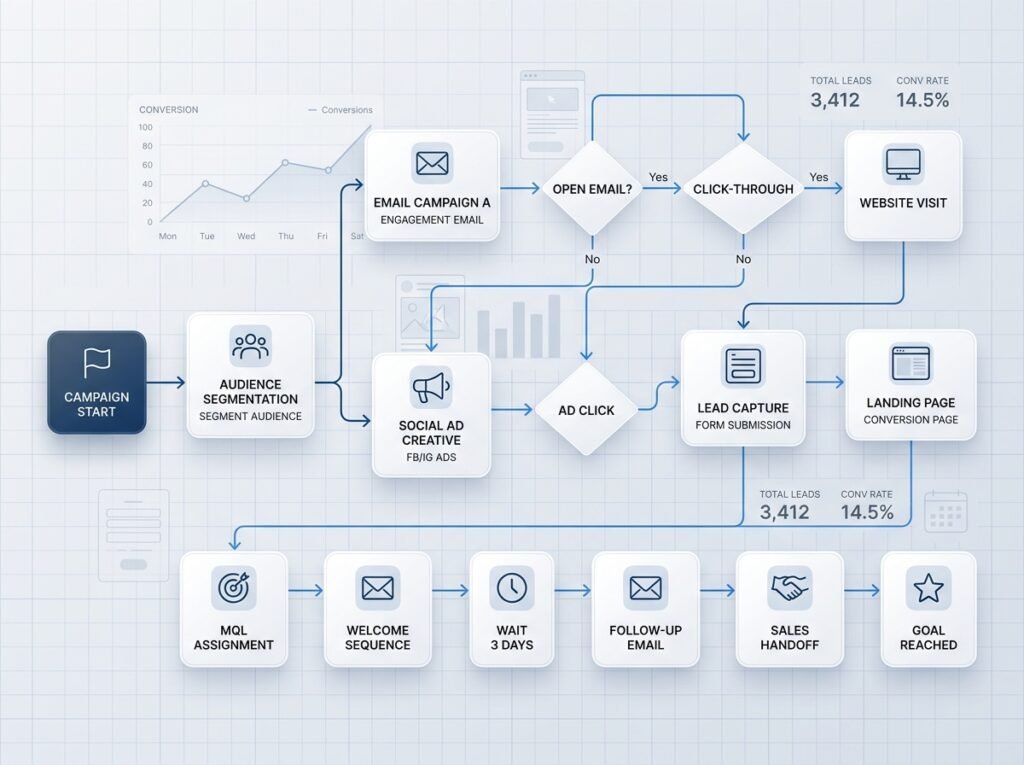
- A lead submits a form, books a call, or messages via your website
- The CRM automatically creates a contact record and enriches it with available data
- The lead is scored or tagged based on source, intent signals, or firmographic data
- An automated confirmation and nurture email fires within minutes
- If the lead meets a threshold, a task or notification routes it to the right person for human follow-up
- Unresponsive leads enter a re-engagement sequence after a set number of days
Tools such as HubSpot, ActiveCampaign, and Brevo all support this workflow at SME-appropriate price points, with no developer resource required to set up the basics.
Where humans still matter
Automation handles the mechanics. Humans handle the nuance. Any lead that falls outside the standard pattern, involves a complex or high-value opportunity, or requires a commercial conversation should be picked up by a person. The goal is to ensure no lead goes cold, not to replace the relationship.
The real cost of not automating this: leads that arrive outside business hours, get buried in inboxes, or simply never receive a timely response. For most SMEs, this is the single biggest source of lost revenue hiding in plain sight.
Workflow 2: Email Nurture and Re-Engagement Sequences
Most SMEs have a list. Very few have a system for working it consistently. Email nurture automation solves this without requiring a dedicated email marketer or a weekly manual send.
According to Klaviyo’s 2026 marketing automation research, AI is increasingly acting as a marketing copilot, recommending triggers, delays, and messaging angles based on customer behaviour patterns. For SMEs, the practical starting point is simpler: build sequences that run automatically based on where someone is in their journey.
A basic nurture sequence for an SME
- Day 0: Welcome or confirmation email with a clear next step
- Day 3: Value-led content (a guide, case study, or insight relevant to their problem)
- Day 7: Social proof or a specific offer relevant to their segment
- Day 14: A direct re-engagement prompt or a soft ask for a conversation
- Day 30+: Move to a lower-frequency nurture track or re-engagement campaign
AI layers on top of this by adapting subject lines, send times, and content variants based on open and click behaviour. Tools like ActiveCampaign and Brevo are particularly well-suited for GDPR-compliant automation at SME scale.
Where humans still matter
Humans should own the offer strategy, the messaging hierarchy, and the approval of any asset that carries significant brand weight, such as a launch email or a key client communication. Automation handles the cadence. Judgement handles the content.
Workflow 3: Content Repurposing and Campaign Asset Production
For most SMEs, the bottleneck in content marketing is not ideas. It is production capacity. A founder records a podcast, writes a blog post, or runs a webinar, and then the asset sits there while the team moves on to the next urgent thing.
AI-assisted repurposing workflows change this equation significantly. QuickBooks research found that 77% of SME owners who use AI report productivity gains, and content production is one of the clearest examples of where that time saving materialises.
Before and after: what this workflow looks like
Without automation:
- Record or write one piece of long-form content
- Manually write social captions, email copy, and short-form variants
- Brief a designer for visual assets
- Schedule each piece individually across platforms
- Repeat from scratch next week
With AI-assisted repurposing:
- Record or write one piece of long-form content
- AI generates a transcript, summary, key quotes, and social variants
- AI tools (such as Canva’s AI features) produce on-brand visual assets
- Scheduling tools queue posts across platforms automatically
- A human reviews, edits for brand voice, and approves before publishing
One UK business using Canva’s AI features reported saving approximately £500 per month on design costs alone. Multiply that across content, copy, and scheduling, and the efficiency case builds quickly.
Where humans still matter
Editorial judgement is irreplaceable. AI can draft and produce, but the angle, the narrative, and the brand voice still need a human to define and protect them. Treat AI as a fast first draft, not a finished product.
Visual workflow builders like n8n allow SMEs to connect marketing tools and automate multi-step processes without writing code.
Workflow 4: Paid Media Reporting and Optimisation Alerts
Manual reporting is one of the most time-consuming and lowest-value activities in a lean marketing team. Pulling numbers from Google Ads, Meta, and LinkedIn into a spreadsheet every week is not strategy. It is data entry.
Automated reporting and alert systems fix this, and the value is immediate. As Misha Williams, COO of GWI, observed in Digital Applied’s 2026 sector commentary: “AI condenses hours of analysis into seconds using human-grounded data.”
Manual reporting vs automated reporting
| Task | Manual approach | Automated approach |
|---|---|---|
| Weekly performance pull | 2-4 hours across platforms | Dashboard updates in real time |
| Budget pacing check | Checked when someone remembers | Automated alert if spend deviates |
| Anomaly detection | Spotted days later, if at all | Flagged immediately via notification |
| Cross-channel view | Built manually in spreadsheets | Unified dashboard with one source of truth |
| Reporting to stakeholders | Formatted and sent manually | Scheduled automated report delivery |
Tools like Google Looker Studio, Supermetrics, and platform-native dashboards can automate most of this without significant technical overhead.
Where humans still matter
Data tells you what happened. Humans decide what to do about it. Budget trade-offs, channel strategy, and decisions about whether a drop in performance signals a structural problem or a short-term blip all require commercial judgement that no dashboard can provide.
Workflow 5: CRM Hygiene, Segmentation, and Customer Journey Triggers
A CRM that is not maintained is not an asset. It is a liability. Duplicate records, stale contacts, and untagged leads mean that any automation built on top of it will produce inconsistent, irrelevant, or outright wrong outputs.
This is why CRM hygiene and segmentation automation belongs early in any SME’s automation roadmap. According to research on UK SME IT challenges, integration challenges and data silos are among the most common barriers preventing businesses from getting value from their tools.
Automating the foundations
- Auto-tagging on entry: Leads are tagged by source, campaign, or product interest at the point of capture
- Lifecycle stage updates: Contacts move automatically between stages (lead, MQL, customer, lapsed) based on behaviour
- Duplicate detection: Automated rules merge or flag duplicate records before they compound
- Re-engagement triggers: Contacts who go quiet for a defined period are automatically enrolled in a win-back sequence
- Suppression lists: Unsubscribes, bounces, and churned customers are automatically excluded from campaigns
Where humans still matter
Lifecycle logic, segmentation strategy, and governance decisions all require human input. Automation can execute the rules, but someone still needs to define what the rules are, review them periodically, and ensure they reflect how the business actually works.
A clean CRM is not a nice-to-have. It is the foundation every other marketing automation depends on.
Workflow 6: Chat and Enquiry Triage
Conversational AI has matured enough to be genuinely useful for SMEs, particularly for handling the volume of routine enquiries that would otherwise eat into team time or go unanswered outside business hours.
The case is not about replacing human interaction. It is about ensuring every visitor gets an immediate, useful response, and that the right enquiries reach the right people without delay.
Where AI chat adds value
- Answering frequently asked questions (pricing, availability, process) consistently and instantly
- Qualifying visitor intent before routing to a human or booking a call
- Capturing contact details and consent from engaged visitors who are not yet ready to speak to someone
- Handling out-of-hours enquiries so leads do not go cold overnight
Where it falls short
- Complex, high-value, or emotionally sensitive conversations
- Situations where nuance, empathy, or commercial judgement is needed
- Any interaction where a scripted response would feel dismissive or damage trust
The key design principle is a clean handoff. When a conversation exceeds what the automation can handle, it should route to a human immediately and with full context, not leave the visitor waiting or starting over.
“Businesses are increasingly expecting support that is helpful, context-aware, and immediate.” (Sparknovus, 2026)
For SMEs, tools like Tidio, Intercom, and HubSpot’s live chat offer accessible starting points that do not require custom development.
Workflow 7: Marketing Planning Support and Campaign Ops
This is the most forward-looking workflow on the list, and the one that rewards SMEs who have already built solid foundations in the earlier six. AI-assisted planning is not yet fully autonomous, but it is already capable of reducing significant operational drag in founder-led businesses.
According to Sparknovus’s 2026 marketing shifts analysis, AI agents are beginning to handle structured marketing work including briefing, segment building, and workflow suggestions. QuickBooks research backs this up with a practical metric: 26% of SME AI users report shorter workdays as a direct result.
How AI supports campaign operations
- Brief generation: AI drafts campaign briefs based on goal inputs, audience data, and past performance
- Idea generation: AI surfaces content angles, subject line variants, and campaign hooks for human review
- Task creation: Campaign plans are broken into tasks automatically and assigned within project management tools
- Cross-channel coordination: Workflow tools like n8n or Make connect platforms so that campaign launches trigger the right actions across email, social, and paid simultaneously
- Post-campaign review: AI summarises performance against goals and flags key learnings for the next cycle
Where humans still matter
Setting priorities, making commercial trade-offs, and deciding what the business should actually say to the market. AI can accelerate execution. It cannot replace the strategic thinking that gives execution its direction.
What to Keep Human, Even as AI Gets Better
The most common mistake SMEs make with marketing automation is not under-automating. It is automating things that should stay human, and then wondering why results feel flat or brand trust erodes.
Here is a clear reference point for where the line sits:
| Automate | Keep human |
|---|---|
| Lead routing and follow-up timing | Qualifying high-value or complex opportunities |
| Email sequence cadence and triggers | Offer strategy, pricing decisions, and key messaging |
| Content drafting and asset production | Final brand voice approval and editorial judgement |
| Reporting data collection and alerts | Interpreting performance and making strategic trade-offs |
| CRM tagging and lifecycle updates | Defining segmentation logic and governance rules |
| FAQ responses and enquiry triage | High-value, sensitive, or relationship-critical conversations |
| Campaign task creation and scheduling | Setting commercial priorities and campaign direction |
As the UK government’s AI adoption research notes, the businesses that struggle most with AI are those that adopt it without a clear sense of the problem it is solving. The same principle applies in reverse: the businesses that get the most from automation are those that are deliberate about where they keep humans in the loop.
The goal is not a fully automated marketing operation. It is a smarter one.
Start With One Workflow, Not a Full-Stack Overhaul
The Azets Q1 2026 Barometer found that while UK business leaders are increasingly committed to digitalisation and AI, many are still in early adoption stages, experimenting rather than embedding. The gap between intent and action is not usually about budget or ambition. It is about not knowing where to start.
The answer is simpler than most people expect: pick one workflow from this list, the one that scores highest on frequency, friction, and financial impact for your business specifically, and build that first.
A practical starting checklist:
- Identify your highest-friction marketing workflow using the three-filter framework
- Map the current process before attempting to automate it
- Choose one tool that integrates with what you already use
- Set a clear success metric before you launch (time saved, leads captured, response rate)
- Review after 60 days and decide whether to expand or adjust
You do not need a transformation programme. You need a working starting point.
If you are not sure which workflow will deliver the most impact for your specific business, a marketing audit is the fastest way to find out. It identifies the bottlenecks, automation gaps, and highest-ROI opportunities across your entire marketing operation, so you can act with confidence rather than guesswork. Find out more about how broden.ai helps SMEs build smarter marketing.
Frequently asked questions
For most early-stage SMEs, lead capture, routing and follow-up is the highest priority and pays back fastest. Lead response time is one of the strongest predictors of conversion, yet in founder-led businesses it is usually handled manually and too slowly. Automating it means no lead goes cold, while people still handle complex or high-value opportunities.
Use three filters: frequency, friction and financial impact. Does the task happen daily or weekly? Does it create delays, errors or manual handoffs? Is it directly tied to lead generation, conversion or retention? A workflow that scores well on all three is your best starting point. Do not automate a broken process, because you will only break it faster.
Keep human anything that needs brand judgement, commercial trade-offs or trust. That includes qualifying high-value opportunities, offer strategy and pricing, final brand voice approval, interpreting performance, defining segmentation rules, sensitive or relationship-critical conversations, and setting campaign priorities. Automation can handle routing, cadence, drafting, data collection, tagging and scheduling.
Because every other marketing automation depends on the CRM. Duplicate records, stale contacts and untagged leads mean anything built on top will produce inconsistent, irrelevant or wrong outputs. Automating auto-tagging, lifecycle stage updates, duplicate detection and suppression lists keeps the foundation clean, while people define and review the segmentation rules.
Pick one workflow, not a full-stack overhaul. Choose the one that scores highest on frequency, friction and financial impact, map the current process first, and use one tool that integrates with what you already have. Set a clear success metric before launch, such as time saved or response rate, and review after 60 days.