For twenty-five years, the deal was simple. You built a website, you earned a ranking, and Google sent you traffic. Position one meant clicks. Clicks meant leads. The whole edifice of small-business marketing rested on that exchange.
That deal is being quietly torn up. Most SME owners can feel it happening. They’ve watched the AI answers creep to the top of the page, they’ve noticed traffic softening even where rankings held, and they’ve used ChatGPT themselves enough to know their customers are doing the same. The awareness is there. What’s missing is a sense of what to actually do about it. The problem no longer feels like ignorance. It feels like standing in front of a shift you can clearly see and having no obvious lever to pull.
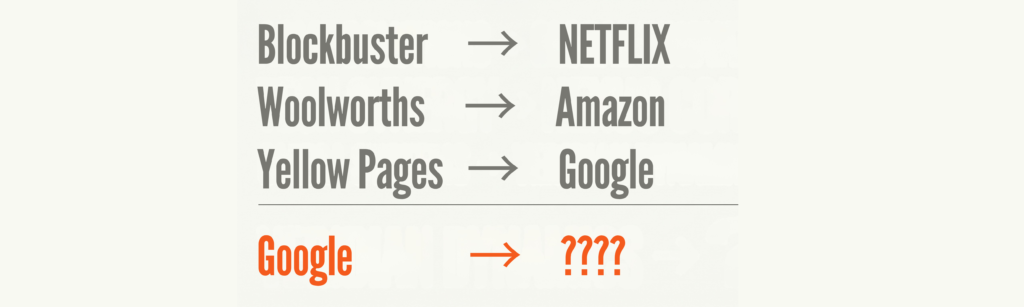
The clearest way to see where this goes is to look at what happened to terrestrial television. It didn’t die in a dramatic collapse. An older generation kept watching broadcast out of habit, so the decline looked gentle from inside the industry. What actually killed it was that a younger generation never arrived. They grew up on streaming and on-demand, and broadcast was never part of how they found anything. There was no switching moment to manage. The audience simply aged out one end while no one came in the other.
Search is on the same trajectory. There is now a generation growing up that will treat asking an AI as the default way to find things, the way an earlier one treated typing into Google and the one before that treated opening a phone book. They are not migrating away from the search box. They are starting somewhere else entirely. For them, the search box was never the front door. That is what makes this irreversible rather than cyclical, and it is why waiting for search to “stabilise” misreads the situation. The decline you can see in the data is the older habit ageing out. The thing replacing it is a generation that never formed the habit in the first place.
The number that should stop you
Gartner forecast that traditional search engine volume would fall 25% by 2026 as AI chatbots and answer engines absorb the queries people used to type into a search box. That figure gets quoted a lot. It also undersells what is actually happening, because volume isn’t the problem. The problem is what happens to the volume that remains.
Search itself is still growing. People are searching more than ever. What has collapsed is the link between a search and a visit to your site. Similarweb measured zero-click searches rising from 56% to 69% between May 2024 and May 2025, a thirteen-point jump in a single year. Roughly seven in ten Google searches now end without anyone clicking through to a website at all.
When the click does happen, it increasingly isn’t yours. Seer Interactive’s analysis of 3,119 informational queries across 42 organisations, covering 25 million organic impressions, found that when an AI Overview appears, organic click-through rate falls 61% and paid click-through rate falls 68%. The same query, the same ranking, a fraction of the traffic.
And the AI Overviews are spreading. Advanced Web Ranking tracked their presence growing from 18.55% of search results in late 2024 to 49.92% by the end of 2025. Half of all searches now carry an answer that resolves the query before the user ever reaches the blue links.
This is not an SEO problem you can fix with better SEO
Here is the part that catches people out. Your rankings can be fine. They can even be improving. And your traffic can still be falling off a cliff.
One documented case showed impressions up 27% year-on-year while clicks dropped 36% and click-through rate fell from 5.98% to 3.35%, despite average rankings improving 14%. Position one organic CTR across the industry fell from roughly 28% to 19% in a single year. You are winning the ranking and losing the visit, because the answer is being delivered above you and the user has no reason to scroll.
This is why the instinct to “just do more SEO” misfires. The discipline was built to win rankings. Rankings are no longer the thing that produces the outcome. You can pour budget into a channel that is structurally returning less every quarter and the dashboard will tell you nothing is wrong, because the ranking held. The leads simply stopped arriving.
That is the marketing intelligence problem in its purest form. The metric you are measuring and the outcome you actually want have come apart, and most SMEs are still optimising the metric.
Run the curve forward
Take what’s measurable and project it on current run rate. Zero-click is climbing thirteen points a year. AI Overview coverage roughly doubled in twelve months. CTR on covered queries has dropped by more than half. None of these trends have a brake on them, and the next five years compound rather than reverse.
If half of searches already resolve without a click today, and AI assistants like ChatGPT, Claude, Perplexity and Gemini keep absorbing the queries that used to start at a search box, then the working assumption for any SME planning its acquisition over the next five years is straightforward: the share of demand that ever reaches your website through traditional search will be a fraction of what it is now. The pipeline you have relied on is narrowing every quarter, and the narrowing is accelerating.
You cannot wait for this to settle before responding, because the businesses being cited in AI answers today are accumulating an advantage that compounds. Brands cited inside an AI Overview earn 35% more organic clicks and 91% more paid clicks than uncited competitors on the same query. Citation is becoming the new position zero, and most companies have no strategy for earning it.
The question that replaces “do we rank?”
For two decades the question was: do we rank for the terms our customers search? The new question, the one that determines whether you exist in the channel your customers are actually using, is this.
Have you invested in making your proposition visible and relevant to the LLMs?
When a prospective customer asks ChatGPT to recommend a supplier in your category, are you in the answer? When they ask Perplexity to compare options, are you cited? When Gemini summarises the field, are you named, or are you invisible?
Right now, for most SMEs, the honest answer is invisible. Not because the business isn’t good, but because nobody has done the work to make it legible to the systems now mediating the decision. The content, the structure, the authority signals, the citations that answer engines draw on were never built, because until very recently they didn’t need to be.
What to do about it
This is what Answer Engine Optimisation is for. Not a rebrand of SEO, but a different discipline answering a different question: how do you become the answer rather than fight for a click that increasingly isn’t there.
The shift moves through four states. Invisible, where the engines don’t surface you at all. Present, where you appear but aren’t the recommendation. Cited, where the engines reference your content as a source. Recommended, where you are the named answer to the question your customer asked. Those states are outcomes the engines decide, not scores you award yourself, which is precisely why you need a structured way to influence the inputs that move you up the ladder.
That structure is what the Broden AI AEO Framework lays out: the twelve parts of getting cited, the five pillars of activity that causally drive visibility, and the practical steps an owner-managed business can actually execute without a large team or a large budget.
Build it into how you work, not onto the side of it
There is a temptation to treat this as a project. Run an AEO audit, tick it off, move on. That is the same mistake as treating SEO as a thing you did once in 2015 and never revisited.
The businesses that win the next decade will be the ones that build AEO into their ways of working. Every piece of content produced with citation in mind. Every claim structured so an engine can extract and attribute it. Visibility in the answer engines monitored as a standing metric, not checked once a year. The same way good marketing teams absorbed SEO into the act of publishing rather than bolting it on afterwards, AEO has to become part of how the function operates day to day. It is not a campaign. It is a habit.
That is also where the opportunity sits. Most of your competitors are still optimising for a channel that is quietly closing. The window in which being early to AEO confers a real, compounding advantage is open now and will not stay open. The brands being cited today are accumulating authority the engines will keep drawing on. By the time the shift is obvious to everyone, the positions will largely be taken.
The businesses that move now will be the cited answers when the transition completes. The ones that wait will spend the next five years watching a channel they trusted quietly stop delivering, with a dashboard that never quite explains why.
The search box is closing. The answer box is open. The only question that matters is whether you’ve built your business to be in it.
Frequently asked questions
Because rankings no longer guarantee clicks. AI answers now appear above the organic results and resolve many queries before users scroll. Seer Interactive found that when an AI Overview appears, organic click-through rate falls 61% and paid click-through rate falls 68%. You can hold or improve a ranking and still lose the visit, so the metric and the outcome have come apart.
A zero-click search is one that ends without the user clicking through to any website, because the answer is shown on the results page. Similarweb measured zero-click searches rising from 56% to 69% between May 2024 and May 2025. That means roughly seven in ten Google searches now end without a click, even though people are searching more than ever.
Not on its own. SEO was built to win rankings, and rankings are no longer what produces the outcome. You can put budget into a channel that returns less every quarter while the dashboard shows nothing wrong, because the ranking held. A different discipline, Answer Engine Optimisation, is needed to become the answer rather than compete for a disappearing click.
Answer Engine Optimisation is the discipline of making your business visible and relevant to AI systems such as ChatGPT, Perplexity and Gemini, so they cite or recommend you. It is not a rebrand of SEO. It moves a business through four states: invisible, present, cited and recommended. Those states are decided by the engines, so the work focuses on influencing the inputs they draw on.
No. AEO should be built into how you work, not run as a single audit. That means producing every piece of content with citation in mind, structuring claims so an engine can extract and attribute them, and monitoring visibility in answer engines as a standing metric. It is described as a habit, not a campaign.