Eighty-two percent of CEOs told Boston Consulting Group (BCG) this year that they are more optimistic about AI returns than they were twelve months ago.
Six percent of companies are actually seeing meaningful value, measured the boring way, in costs that came down or revenue that went up.
Sit with that gap for a moment, because it isn’t the story we usually tell. This isn’t adoption failing to happen. Adoption happened. Nearly every business I walk into is using this stuff somewhere. The gap says something less comfortable: adoption was never the thing worth measuring in the first place.
Faster is not the same as compounding
Here is the split I keep seeing.
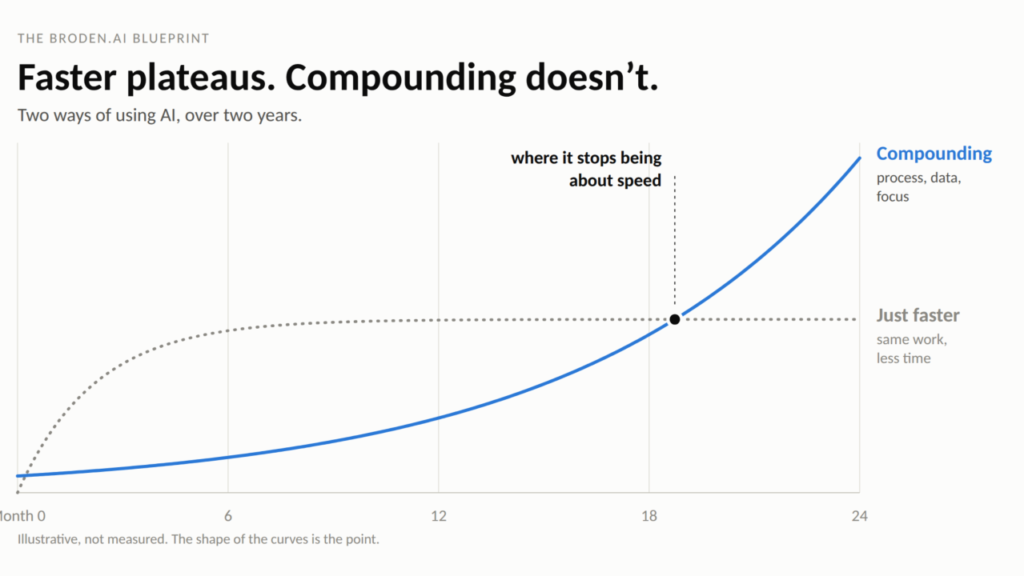
One business uses AI to get the same work done in less time. The proposals go out quicker, the first drafts write themselves, someone’s Tuesday afternoon comes back. Real gains. But they are gains you bank once. Six months in, the curve flattens, because the work is the same shape as it always was, just moving faster through the same pipes.
The other business is quietly building something. Every month, the way they use AI gets better than the month before, because there is more underneath it: processes that got written down, data that got cleaned up, a way of working that got sharper. That’s not speed. That’s compounding. And it looks unremarkable for about three quarters, right up until it doesn’t.
Almost everyone is in the first group and thinks they are in the second.
What compounding actually looks like
Three things separate them, and none of them are tools.
The first is data. AI is all about the data. What you’re feeding into it will dictate the quality of the output. Give a person a rubbish brief and they’ll deliver a rubbish output; the machine is no different, it’s just faster and more confident about it. Most organisations can find pockets where AI helps. Very few have the data channels required to make genuinely good decisions with it. The businesses that are compounding spent the unglamorous months fixing that.
The second is process. BCG’s finding on the successful six percent is that they redesign end-to-end processes around AI-enabled decisions, rather than bolting AI onto workflows that were built for humans. At the scale most of us operate at, that sounds grander than it is. It usually means noticing that a step in your process exists only because a person used to have to do it, and then removing the step rather than automating it.
This is why I don’t lead with the tool. My order is: what do we know about the market, then what does the strategy need to be, and only third, is there anything out there that makes this easier or cheaper? Going straight to the tool tends to fix a problem without touching the actual issue.
The third is concentration. The six percent put their weight behind a small number of initiatives with real potential impact. The plateau crowd runs eleven pilots and finishes none of them.
The part nobody puts in the board pack
There’s a reason this is hard, and it isn’t ignorance.
I was talking about this recently with two consultants who spend their working lives with leadership teams. One of them made the point that lands it: it is far more convincing to tell people “this will improve your EBITDA” than to say “we are going to spend our time working out how we do stuff properly.” As he put it: not as sexy in the board papers, is it?
He’s right. “Do things properly” has never once survived contact with an annual objectives document. “Transformational AI implementation” sails through. So there is constant pressure on organisations, and on the individuals inside them, to be seen to be with the times, while plenty of people are happy to sell you the idea that you can sit back and let it run.
His colleague put the same thought in the line I keep coming back to: you can’t really outsource your problems to AI. You still have to make your own decisions and find your own way ahead.
Three questions
None of this means speed is the wrong choice. If you’re a small team and you’ve genuinely got six hours a week back, that’s a good year’s work. The failure mode isn’t choosing speed. It’s believing you’re compounding when you’re not, and being surprised in eighteen months when the gains quietly stop arriving.
So, three questions worth answering honestly this week:
- What do you have now, because of AI, that you didn’t have six months ago, and that isn’t just time saved?
- If your best AI tool vanished tomorrow, would anything of value remain?
- Which of your processes has actually changed shape, rather than just got quicker?
The businesses that look untouchable in two years won’t be the ones that adopted earliest. They’ll be the ones that turned adoption into an asset while everyone else was reporting on usage.
Which of those three questions was hardest to answer? Get in touch and tell me.
Frequently asked questions
Because they measure adoption rather than outcomes. Nearly every business is using AI somewhere, but BCG found only around six percent are seeing meaningful value in lower costs or higher revenue. Using AI to do the same work faster produces gains you bank once, and they flatten within months.
Speed gains come from doing the same work faster, and they plateau because the work keeps the same shape. Compounding gains come from building something underneath: documented processes, clean data and a sharper way of working. Those make each month’s use of AI better than the last.
Three things, none of them tools. Data good enough to support decisions. Processes redesigned around AI rather than AI bolted onto old workflows. And concentration on a small number of high-impact initiatives instead of many unfinished pilots.
Ask three questions. What do you have now, because of AI, that isn’t just time saved? If your best AI tool vanished tomorrow, would anything of value remain? Which of your processes has actually changed shape, rather than just got quicker?
Start with what you know about the market, then decide what the strategy needs to be, and only then look for tools that make it easier or cheaper. Going straight to the tool tends to fix a symptom without touching the underlying issue.