Most businesses do not waste marketing budget because they choose the wrong supplier. They waste it because they solve the wrong problem first.
A founder hires a marketing agency when the real issue is unclear positioning. A managing director buys AI tools when the team has no defined process to automate. A board asks for more leads when no one has agreed which market, message, offer, or sales motion should be prioritised. The result is familiar: more activity, more reporting, more content, more meetings, but no clearer path to growth.
This is why the question, “Should we hire a fractional CMO, a marketing agency, or use AI tools?” is rarely a procurement question. It is a leadership question.
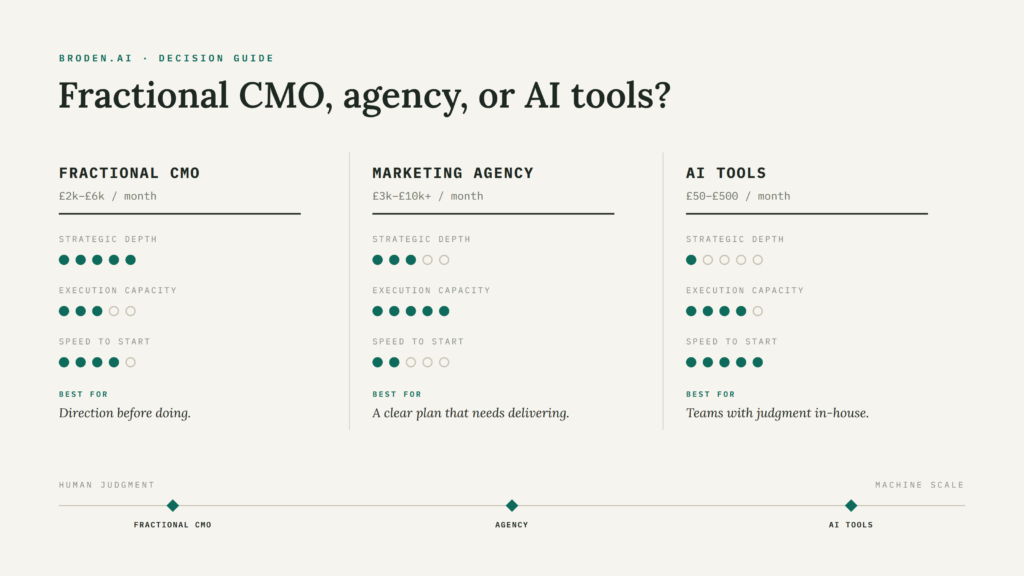
Each option can be valuable. A fractional CMO brings senior marketing judgement and commercial accountability. A marketing agency brings specialist execution and delivery capacity. AI tools bring speed, efficiency, and operational leverage. The mistake is treating them as interchangeable.
They are not.
A fractional CMO is not simply a cheaper version of a full-time marketing director. An agency is not automatically a substitute for strategic leadership. AI tools are not a marketing strategy, however impressive the output may look. They solve different business constraints, and the order in which you use them matters.
For most growing businesses, the decision comes down to three questions:
- Do you lack clarity?
- Do you lack capacity?
- Do you lack speed?
If you lack clarity, you probably need senior marketing leadership. If you lack capacity, you may need an agency or specialist delivery partner. If you lack speed, AI tools may help you remove friction and increase output. If you lack all three, you need to sequence the solution carefully, because buying everything at once often creates more complexity rather than more growth.
The real problem: marketing has become easier to do and harder to lead
Marketing has never been more accessible. A business can launch ads in a day, build landing pages without developers, publish content at scale, automate email sequences, generate creative concepts with AI, analyse customer data, and track performance across dozens of platforms.
On the surface, this looks like progress. In practice, it has created a new leadership problem.
When execution becomes easier, the cost of unclear strategy rises.
A team can now produce campaigns faster than the business can judge whether they are the right campaigns. AI can generate more content than the brand has the authority to sustain. Agencies can deliver more channel activity than the leadership team can interpret. Dashboards can show more data than the board can meaningfully use.
The issue is no longer whether marketing activity can be produced. The issue is whether that activity is commercially coherent.
This is where many businesses get stuck. They are busy, but not focused. They are visible, but not distinctive. They are investing, but not confident. They have suppliers, tools, and channels, but no single marketing leader connecting the work to growth.
That gap is often misdiagnosed.
If sales are inconsistent, the answer is not always more leads. If website conversion is weak, the answer is not always a redesign. If content is underperforming, the answer is not always more content. If an agency is not delivering, the answer is not always a new agency.
Sometimes the business needs sharper direction before it needs more delivery.
What a fractional CMO actually solves
A fractional CMO gives a business access to senior marketing leadership without hiring a full-time executive. The value is not simply time. It is judgement.
The right fractional CMO helps the leadership team answer the questions that sit above channel execution:
- Which customer segments matter most?
- What position should the business own in the market?
- Where is marketing spend being wasted?
- Which channels deserve investment now, and which should wait?
- What should the agency, internal team, and sales function be focused on?
- How should success be measured at board level?
Where can AI create genuine leverage rather than more noise?
This is a different role from a campaign manager, consultant, freelancer, or agency account lead. A fractional CMO sits closer to the commercial centre of the business. They connect marketing with sales, revenue, product, customer insight, pricing, positioning, and growth strategy.
That makes them particularly useful when a business has reached the stage where informal marketing no longer works.
In the early days, founder-led marketing can be enough. The founder knows the customer, shapes the message, closes the deals, and makes the calls. But as the business grows, that model starts to break. More people become involved. More channels are added. More budget is committed. More suppliers appear. The founder can no longer hold the entire growth system in their head.
At that point, the business does not just need “marketing help”. It needs marketing leadership.
A fractional CMO is often the right answer when the business is doing plenty of marketing but cannot confidently explain what is working, what should stop, or what should happen next.
What a marketing agency actually solves
A marketing agency solves a different problem. It gives the business execution capacity and specialist expertise.
That might mean paid media, SEO, content, design, web development, PR, brand, social media, creative production, or campaign delivery. A good agency can bring experience, process, tools, and channel knowledge that the business does not have internally.
Agencies are at their best when the brief is clear.
If the business knows the market it wants to win, the audience it wants to reach, the offer it wants to promote, the budget it is prepared to invest, and the commercial outcome it expects, an agency can be extremely effective.
The problem comes when an agency is asked to compensate for a leadership gap.
Many agencies are hired with a brief that sounds simple but is commercially vague: “We need more leads”, “We need better marketing”, “We need to grow faster”, “We need to improve the brand”, or “We need AI content”. Those statements may be true, but they are not yet a strategy.
Without senior direction, an agency may still produce work. It may launch campaigns, write content, redesign pages, manage ads, report on performance, and make recommendations. But the work can become disconnected from the bigger commercial decisions the business has not made.
That is not always the agency’s fault.
Agencies need context, prioritisation, and decision-making. They need someone client-side who can judge the trade-offs, connect activity to revenue, and make sure the work supports the business strategy. In larger companies, that person is often a CMO or marketing director. In growing businesses, that role is frequently missing.
This is why a fractional CMO and an agency can work well together. The fractional CMO sets the direction, sharpens the brief, manages priorities, and holds the work commercially accountable. The agency delivers the specialist execution.
The combination is often stronger than either option alone.
What AI tools actually solve
AI tools solve another problem again: speed.
They can help teams research faster, draft faster, analyse faster, summarise faster, report faster, and create variations faster. Used well, AI can reduce manual work and improve the productivity of both internal teams and external partners.
For growing businesses, this matters. Many marketing teams are under-resourced. They are expected to produce more content, support sales, manage campaigns, analyse performance, improve customer journeys, understand new platforms, and keep up with changing buyer behaviour. AI can remove some of that operational drag.
But AI has a clear limitation: it accelerates the system you already have.
If the system is strong, AI can make it more efficient. If the system is confused, AI can make the confusion faster.
A business with weak positioning can use AI to produce more messaging, but it will not necessarily become more distinctive. A business with no clear content strategy can publish more articles, but it will not necessarily build authority. A business with poor sales and marketing alignment can automate follow-up, but it will not necessarily improve conversion.
AI tools are powerful, but they do not take responsibility.
They do not decide which market you should prioritise. They do not carry the commercial risk of a budget decision. They do not resolve board-level disagreement. They do not understand the political reality of your team, your customers, your margins, or your sales cycle unless that judgement is designed into the process by people who do.
The question is not whether AI should be used in marketing. It should. The question is whether the business has enough strategic clarity to use it well.
Frequently asked questions
Start by asking whether your business lacks clarity, capacity or speed. If you lack clarity, you probably need senior marketing leadership such as a fractional CMO. If you lack capacity, an agency or specialist delivery partner may help. If you lack speed, AI tools can remove friction. If you lack all three, sequence the solution carefully rather than buying everything at once.
Usually not. An agency brings specialist execution and delivery capacity, and it works best when the brief is clear. Problems arise when an agency is asked to fill a leadership gap with vague briefs like “we need more leads”. Agencies need someone client-side who can judge trade-offs, set priorities and connect activity to revenue. In growing businesses, that role is often missing.
Often, yes. The two solve different problems. The fractional CMO sets the direction, sharpens the brief, manages priorities and holds the work commercially accountable. The agency delivers the specialist execution, such as paid media, SEO, content or design. Used together, the combination is often stronger than either option alone, because execution is connected to the bigger commercial decisions.
No. AI tools bring speed, helping teams research, draft, analyse and report faster, but they accelerate the system you already have. If the system is strong, AI makes it more efficient. If it is confused, AI makes the confusion faster. AI does not decide which market to prioritise or carry the commercial risk of a budget decision. People with judgement still have to do that.
When informal, founder-led marketing stops working. As a business grows, more people, channels, budget and suppliers get involved, and the founder can no longer hold the whole growth system in their head. A clear sign is doing plenty of marketing but being unable to explain confidently what is working, what should stop and what should happen next.